

11/25/2025 | LinkedIn
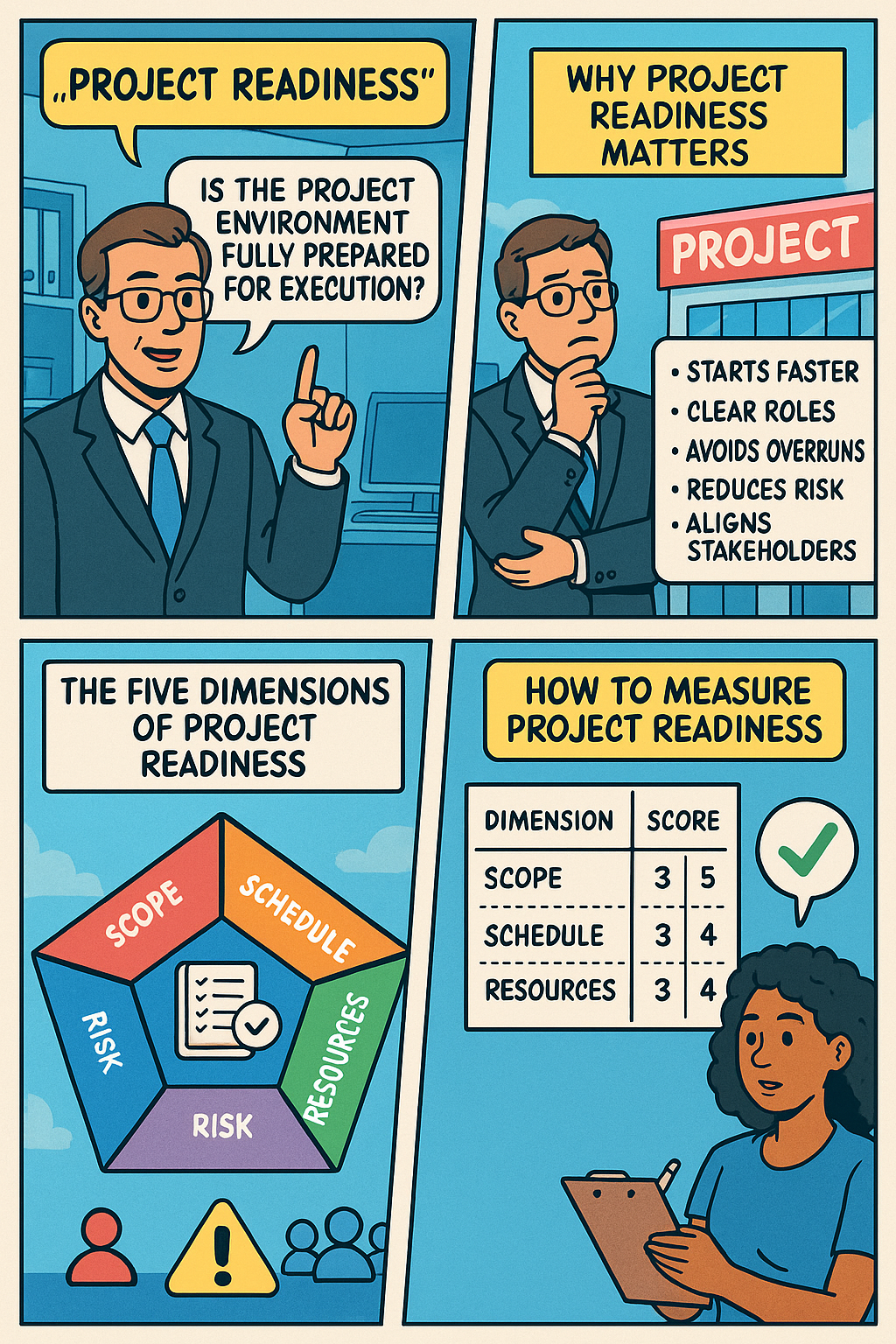
Most project failures don’t happen inside the execution phase. They happen before the project even begins — when organizations assume they are ready, but the fundamentals are missing, unclear, or misaligned.
That is why the concept of Project Readiness matters. It is the discipline of ensuring that the project environment — technical, organizational, and human — is fully prepared for execution. In other words: Can this project truly start tomorrow without surprises?
Why Project Readiness Matters
A “ready� project:
Starts faster and with fewer disruptions
Has clear roles, expectations, and decision paths
Avoids budget/time overruns caused by ambiguity
Reduces risk by validating assumptions early
Aligns stakeholders around the same reality — not the same hope
Project readiness is not about optimism. It is about verifiable conditions that support a predictable outcome.
The Five Dimensions of Project Readiness
1. Scope Readiness
A clear and agreed definition of “what we are building�
Documented boundaries: in-scope, out-of-scope, constraints
Stable requirements and a validated technical concept Key question: Can any stakeholder describe the project in one paragraph consistently?
2. Schedule Readiness
A realistic timeline based on real capacities
Identified dependencies and resource constraints
Buffering strategy for critical-path risks Key question: Is the schedule an honest forecast or a political compromise?
3. Resource Readiness
The right people available at the right time
Tools, systems, procurement, and vendors prepared
Team trained and onboarded before work starts Key question: If we start on Monday, do we actually have everything?
4. Risk Readiness
A living risk register with mitigation ownership
Early identification of “unknowns� and non-technical risks
Decision paths for escalation Key question: Do we know what can go wrong — and are we ready for it?
5. Stakeholder Readiness
Clear governance: roles, responsibilities, decision authorities
Alignment on priorities, success criteria, and communication
Commitment from all parties — internal and external Key question: Is everyone ready to support the project, not just observe it?
How to Measure Project Readiness
A practical method is to use a readiness scorecard with measurable indicators across the five dimensions:
DimensionIndicators (examples)Score (0–5)Scopeclarity, stability, documentation, approvals0–5Schedulerealism, dependencies managed, buffers0–5Resourcesteam assigned, vendors onboard, procurement secured0–5Risksregister complete, mitigations active, owners defined0–5Stakeholdersalignment, governance, communication set0–5
A project is considered ready when:
No area is below 3/5, and
Overall average is ≥ 4.0, and
All critical risks have mitigation owners.
This creates transparency. No politics. No guesswork. Just readiness vs. non-readiness.
Project Readiness as a Competitive Advantage
Organizations that invest in readiness deliver:
More predictable outcomes
Lower execution stress
Higher trust between stakeholders
Fewer crisis-driven decisions
In fast-moving industries, readiness becomes a strategic differentiator — a sign of maturity and operational excellence.
PF Automation & Digital Solutions. Unbiased Expertise. Industrial Results.
https://www.linkedin.com/company/pf-ads/
#PFADS #ProjectReadiness #ProjectManagement #EngineeringLeadership #RiskManagement #IndustrialDigitalization #ExecutionExcellence #UnbiasedExpertise #AutomationProjects #Consulting